
Centrifugal separator and centrifugal filter for industrial solid-liquid separation in Indonesia
Source:
Author:
Hui Bo
Release time:
2026.11.18
Contents
- Centrifugal separator or centrifugal filter? The terms buyers in Indonesia actually use
- How sedimentation centrifuges work: Stokes, pool depth and the solid bowl
- How filtration centrifuges work: cake permeability, washing and the perforated basket
- Separation factor g: what it means and how to calculate it
- Choosing a centrifugal separator by feed: a decision matrix
- Tubular, disc and decanter: where each sedimentation machine belongs
- Settling and filtering in one drum: the role of a screen-scroll hybrid
- Centrifugal separation across Indonesia: a material-by-material map
- Bench tests, pilot runs and scale-up for process plants in Indonesia
- Huibo centrifuge families mapped to sedimentation and filtration
- Related topics
- Frequently asked questions
Ask three engineers in Indonesia what a centrifugal separator is and you may get three different machines. One will describe a high-speed disc unit that strips oil from water on a palm line. Another will point at a decanter on a wastewater plant. The third will mean a perforated basket spinning wet salt or fertiliser crystals dry. All three are right, because "centrifugal separator" is a search phrase and a purchasing habit, not a machine type. The same is true of "centrifugal filter", "bowl centrifuge" and "centrifugal extractor".
This article sorts those terms into the two physical mechanisms that actually matter, sedimentation and filtration, and then shows how feed properties decide which one a given slurry needs. It covers the separation factor with worked numbers, a feed-based selection matrix, the role of a combined settling-and-filtering machine, and how bench tests predict full-scale behaviour. It is written for process and maintenance engineers at Indonesian plants who must write a sensible enquiry before talking to any supplier. Details that belong to a single machine or industry are handled in a one-line pointer to the relevant article, starting with the decanter centrifuge guide for Indonesia.
Centrifugal separator or centrifugal filter? The terms buyers in Indonesia actually use
Every term below shows up in enquiries, in supplier catalogues and in plant slang. The table translates each one into the mechanism underneath. The mapping is not perfect, since regional usage varies from mill to mill, but it holds often enough to be a useful first filter.
| Term heard on site | What it usually means | Mechanism | Typical machine family |
|---|---|---|---|
| Centrifugal separator | Umbrella word; most often a liquid-liquid or liquid-solid clarifier running at high speed | Sedimentation | Disc stack, tubular, decanter |
| Centrifugal filter | A machine with a screen or cloth that lets liquid through and holds solids back | Filtration | Pusher, scraper (peeler), basket, screen-scroll |
| Solid bowl centrifuge | A bowl with a solid wall; nothing escapes except over the weir or through the solids outlet | Sedimentation | Decanter, tubular, solid-bowl disc |
| Bowl centrifuge | Loose term; may mean a solid bowl or simply "the rotating drum" | Either; check the wall | Any |
| Basket centrifuge | A cylindrical basket, perforated or solid, usually vertical, often batch | Mostly filtration | Scraper, peeler, top-suspended, bag-lifting |
| Centrifugal extractor | Either a perforated-basket spin dryer (the "hydro-extractor" of textile and food plants) or a liquid-liquid contactor used in chemistry | Filtration, or liquid-liquid contacting | Basket machine; annular contactor |
| Continuous flow centrifuge | Feed in and products out without stopping, as opposed to batch loading | Either | Decanter, pusher, disc, tubular (with limits) |
| Tubular centrifuge | A tall, narrow bowl at very high speed, solids collected inside | Sedimentation | Tubular bowl |
Two traps appear in almost every Indonesian enquiry. The first is "centrifugal extractor", which a buyer may use for a spin dryer while the supplier hears a chemical contactor, so the offer that comes back is for the wrong machine. The second is "bowl centrifuge", which carries no information at all until someone asks whether the wall is solid or perforated. A single clarifying question, "does your product leave through a screen or over a weir?", removes most of the confusion.
How sedimentation centrifuges work: Stokes, pool depth and the solid bowl
In a solid bowl centrifuge the liquid forms a ring against the inside of the wall, and particles that are denser than the liquid migrate outward through that ring. Their drift speed follows Stokes' law: it rises with the square of the particle diameter, with the density difference between solid and liquid, and with the acceleration, and it falls in proportion to the liquid viscosity.
Put numbers on it. A 10 µm mineral particle of density 2,600 kg/m³ in water at room temperature settles at roughly 0.09 mm/s under ordinary gravity. To fall one metre in a tank takes more than three hours. Spin the same slurry at 2,000 g and the drift speed becomes about 0.17 m/s in the idealised case, so the few centimetres across the liquid ring are crossed in a fraction of a second. Shrink the particle to 1 µm and the speed drops a hundredfold, which is why very fine material pushes engineers toward higher g, longer residence time or a flocculant. Real slurries settle more slowly than the ideal figures because crowded particles hinder one another, but the ratios remain the guide.
What a solid bowl can and cannot do
A solid-wall machine has no screen to blind, so it tolerates a wide range of particle size, soft or sticky solids and feeds that vary from hour to hour. Its weakness is the other end of the process: the cake leaves wetter than a filtration machine would deliver, because the liquid held between particles has nowhere to drain except back through the cake. The decanter, the tubular bowl and the disc machine are all solid-bowl devices; they differ in how they remove the settled layer (a conveyor, manual cleaning, or periodic and nozzle discharge). The mechanics of the decanter itself are covered in the first article of this series, so only the deciding point is repeated here: a sedimentation machine wins when the solids will not form a free-draining cake.
How filtration centrifuges work: cake permeability, washing and the perforated basket
A centrifugal filter turns the same rotating field into a pressure difference. The wall is perforated and carries a screen or filter cloth. Liquid is forced through, solids stay behind and build a cake, and the liquid left in the cake keeps draining as long as the basket spins. The driving pressure grows with the square of the speed and with the radius, but the real limit is the cake itself. How fast liquid moves through the cake depends on its permeability, and permeability collapses as particles get smaller or as the size range gets wider, because small grains fill the gaps between large ones.
That is why filtration machines are the answer for crystals, granules and short fibres, and a poor answer for fine mud. Coarse, narrow-sized crystals form an open cake that drains to a low residual moisture within seconds. A slurry that contains a fine fraction, even a small one, tends to blind the screen: the throughput falls, the cake turns glossy and the basket loads unevenly, which shows up as vibration. As a rule of thumb, free-draining cakes form comfortably above roughly 50–100 µm; scraper machines with a cloth can work in the tens of microns; below that, a sedimentation or combined machine is usually the safer choice.
Washing is the filtration advantage
Because the cake is a bed of solids with open channels, wash liquid can be sprayed over it and displaced through it. Mother liquor, dissolved salts or colour are rinsed off the crystal surface, and the final spin removes most of the wash. A sedimentation machine can wash only by re-slurrying and settling again, which takes extra stages. When the product specification includes a limit on soluble impurity, wash capability is often the deciding factor rather than throughput. How the different filtration machines discharge the cake and what that does to residual moisture is left to the article on centrifugal dewatering machines.
Separation factor g: what it means and how to calculate it
The separation factor, also called relative centrifugal force or RCF, compares the acceleration inside the bowl with ordinary gravity. It is the single number most often printed on a data sheet and most often misread.
The formula is g-factor = ω²r / 9.81, where ω is the angular speed in radians per second (2π × rpm ÷ 60) and r is the radius in metres at the point of interest. In practice the radius should be the one at the liquid surface for clarification calculations and at the bowl wall for the maximum figure; data sheets normally state the wall value.
| Example | Bowl radius | Speed | Wall speed | Separation factor |
|---|---|---|---|---|
| Solid bowl, 400 mm diameter | 0.20 m | 3,000 rpm | about 63 m/s | about 2,000 g |
| Filtration basket, 1,200 mm diameter | 0.60 m | 1,000 rpm | about 63 m/s | about 670 g |
| Tubular bowl, 100 mm diameter | 0.05 m | 15,000 rpm | about 79 m/s | about 12,600 g |
Compare the first two rows. The wall speed is almost identical, which is what the bowl material and bearings feel, but the separation factor differs by a factor of three because the smaller bowl spins faster. This is the reason a small high-speed machine can clarify what a large slow basket cannot. And because g rises with the square of speed, a ten percent speed increase gives about a twenty-one percent g increase, with a matching rise in stress on the rotor.
Typical Industry Reference Values by Centrifuge Principle
One more concept appears in the more technical catalogues: the sigma factor, an equivalent clarifying area that combines g, bowl geometry and flow. Sigma lets a supplier compare a small tubular machine with a larger decanter on equal footing and scale a test result to a production unit. Engineers need not calculate it, but should know the term when a supplier uses it in a proposal.
Choosing a centrifugal separator by feed: a decision matrix
The matrix below starts from the feed rather than the machine. Fill the left side with the data from your own slurry, read across, and treat the result as a shortlist for a test, not a final choice.
| Feed property | Favours sedimentation (solid bowl) | Favours filtration (screen or cloth) | Favours combined machine |
|---|---|---|---|
| Particle size | Fine to medium, a few microns up | Coarse, tens of microns to millimetres | Wide range with a coarse part and a fine part |
| Size distribution | Wide is acceptable | Narrow is better; fines blind the screen | Wide distribution |
| Solids concentration | Very low to moderate | Moderate to high, often thick suspensions | Low to moderate with fines |
| Cake behaviour | Soft, sticky or compressible | Free-draining, incompressible | Partly draining after thickening |
| Washing needed | Limited; re-slurry stages | Yes, on the cake, in machine | Light wash possible |
| Target product | Clear liquid or thickened solids | Dry, washed solids | Clear filtrate and drier cake |
| Two liquid phases | Yes (three-phase decanter or disc) | No | No |
| Crystal fragility | Gentle on feed, scroll may break crystals | Gentle if loaded softly | Moderate |
Three common outcomes come out of this table. A coarse crystalline product such as salt or fertiliser, where the sale is of dry washed solid, points to filtration. A fine, soft or variable solid where the customer needs either clear liquid or a manageable cake, such as wastewater sludge, points to sedimentation and to the sludge dewatering centrifuge article for the detail. A mixed stream with coarse grains and a tail of fines is the case where a hybrid is worth testing.
Tubular, disc and decanter: where each sedimentation machine belongs
Among sedimentation machines the choice is mostly about solids load and about how the solids leave.
The tubular centrifuge is the highest-g, simplest-geometry option: a tall, narrow bowl, feed entering at the bottom, clarified liquid flowing out at the top, solids collecting on the wall until the run is stopped and the bowl is cleaned by hand. It suits very fine particles at low solids and small flows, which is why it appears in laboratories, pharmaceutical work and specialty chemicals, and rarely on high-tonnage lines.
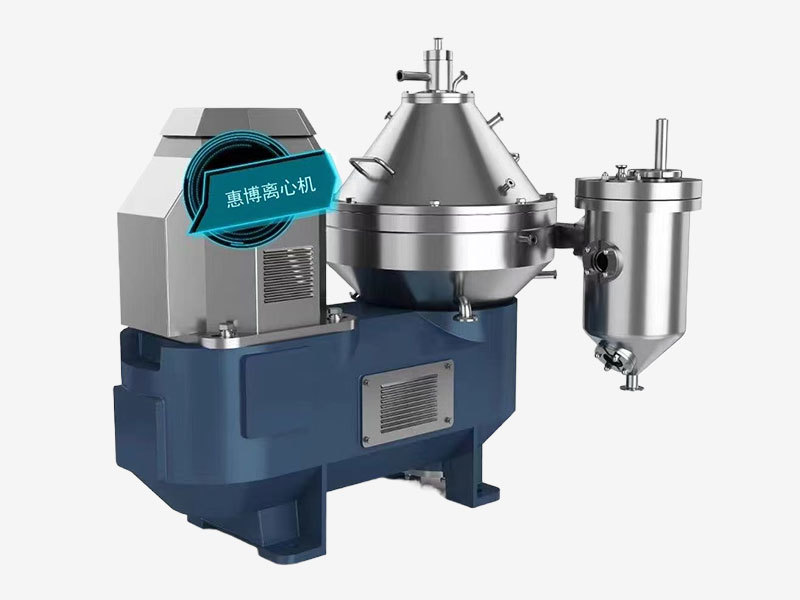
The disc stack machine adds a stack of conical discs that shortens the settling distance and gives a large equivalent clarifying area, so it can handle larger flows with fine solids or a liquid-liquid split. It carries only a modest solids load and discharges periodically or through nozzles. How the stack, interface and discharge work is explained in the article on disc-type oil-water separation; here it is enough to note that it belongs at the low-solids, fine-particle end of the choice.
The decanter takes the heavy end: high solids, a wide size range, continuous cake removal by a scroll, and feeds that move around. It gives up some fineness, since its g is lower than that of a disc or tubular machine, and it delivers a wetter cake than a filtration machine. For a plant that wants a continuous flow centrifuge on a variable stream, it is usually the first machine to test.
Settling and filtering in one drum: the role of a screen-scroll hybrid
Some feeds fall between the two mechanisms. A decanter produces a cake that is wetter than the customer wants, but a basket would blind on the fine fraction. A pure filtration machine could handle the coarse part, but its throughput would collapse on the thin, dilute feed. A hybrid, usually called a screen-scroll or screen-bowl machine, puts both in one rotating assembly.
The layout is simple to describe. The first section of the bowl is solid and behaves like a decanter: a dilute feed settles, the fine fraction concentrates and the scroll carries the thickened solids forward. At the end of the bowl the wall turns into a screen. The thickened solids now behave as a cake on that screen, and liquid drains through while the scroll keeps conveying the solids to the discharge. In the best case the settling zone removes the fines that would have blinded the screen, and the screen zone delivers a drier cake than a plain decanter. Some designs allow a wash in the filtration zone.
The trade-offs deserve honesty. A hybrid has more wear surfaces, the screen can still blind or tear on abrasive solids, and its performance depends strongly on how the feed behaves at the transition between zones. It is not a universal upgrade; it is a specific answer to a feed that is too fine for a pure filter and too coarse and dry-hungry for a pure decanter. The only reliable way to know is a test with a representative sample, which is also why the product section below presents it as an option to be tried rather than a promise.
Centrifugal separation across Indonesia: a material-by-material map
Indonesian plants span a wider mix of feeds than almost any single country: tropical agriculture, coal, chemicals, industrial parks around Jakarta and Surabaya, and a long coastline. That mix means the terminology confusion described earlier wastes real time in specification work. The notes below place the common Indonesian materials on the sedimentation-filtration map and send each one to its own article for depth.
- Crystalline salt and fertiliser crystals: coarse, free-draining and washable, so these are filtration jobs, usually a pusher. Salt-making areas such as Madura and other coastal districts deal with saturated brines and coastal humidity that attack electrical cabinets as much as the machine itself.
- Coal fines and coarse mineral products in Kalimantan and Sumatra: a coarse fraction suits filtration; a fine and clay-rich fraction tends to blind the screen, which is the situation where a decanter or hybrid is tested.
- Sugar: sucrose crystals from a massecuite are a filtration job in batch or continuous machines, with wash water to remove the molasses film.
- Cassava starch paste, for example from the Lampung region: very fine granules that blind any fine screen, so washing and concentrating are typically sedimentation tasks; the filtration machine enters only for dewatering a thickened starch cake, which is handled in the dewatering article.
- Chemical slurries in industrial estates around Cilegon, Gresik and Cikarang: a very mixed bag; crystalline products go to filtration and fine precipitates to sedimentation, always subject to corrosion limits on the wetted parts.
- Wastewater sludge: a soft, compressible, fine solid that is a classic sedimentation job; see the sludge article for polymer, cake dryness and troubleshooting.
Field conditions matter as much as chemistry. Hot, humid air increases the risk of moisture in motor terminal boxes and control cabinets; water-cooled or oil-lubricated components must tolerate high ambient temperature; and rainy-season changes in raw material water content move the feed concentration. A cassava mill or sugar mill that runs seasonally also meets the problem of long idle periods, so it is wise to flush and dry the rotor properly before standing. Palm and edible-oil processing, which dominate Sumatra and Kalimantan, are liquid-liquid tasks and belong to the series' separate articles, for example the three-phase decanter article for Indonesian palm oil mills.
Bench tests, pilot runs and scale-up for process plants in Indonesia
A beaker and a small laboratory centrifuge predict much more than most plant managers expect, provided the test is designed for a decision. The tests below are conceptual, not a procedure, but they show what each one tells.
Tests for sedimentation
Start with a beaker or measuring cylinder. Let the slurry stand, watch whether solids form a sharp interface or a diffuse haze, and note the clear liquid after fifteen minutes and after an hour. A sharp interface with fast clearing suggests that a modest g will do. A haze that persists points to fine or colloidal particles that will need a flocculant or high g.
Then use a laboratory swing-out centrifuge with tubes. Spin samples at several speeds and times, and read two things: the clarity of the supernatant and the solids packing at the bottom, expressed as cake solids or a measured volume. Plot clarity against g multiplied by time and you have a first picture of how hard the separation is. This works because, in the idealised case, the same particle needs the same product of acceleration and time to cross the same distance. It is a screening tool, not a sizing tool: a tube has no scroll, no pond depth control and no continuous flow.
Tests for filtration
A laboratory vacuum filter or a small basket test shows how fast liquid leaves the sample and how dry the cake becomes after a given spin time. Measure the filtrate rate, the residual moisture after spinning and the effect of a wash. Crystal breakage under the loading and discharge forces can be checked under a microscope. If the filtrate slows to a trickle early, the cake is low in permeability and a basket will blind in service.
From bench to production
A pilot unit is the next step when the product is valuable or the feed unusual. It adds the elements the tubes lack: continuous flow, controlled pond depth, a scroll or pusher and realistic residence time. Scale-up from pilot to production then relies on matching g and on scaling flow with the equivalent clarifying area (sigma) for sedimentation, or with basket area and cycle time for filtration. A competent supplier will bring this method rather than a pure model-number guess.
Huibo centrifuge families mapped to sedimentation and filtration
Huibo makes machines on both sides of the sedimentation–filtration divide, and one that combines the two, so an Indonesian plant can match the machine to its feed rather than the other way round. The working ranges in the table come from its website.
| Principle | Family | Working range |
|---|---|---|
| Sedimentation | LW and LWS decanters | Solid-liquid separation and liquid clarification; LWS for three-phase feeds |
| Sedimentation plus filtration | LWLZ series | Sedimentation section and filtration section in one drum |
| Filtration | HR pusher | About 0.05–5 mm, solids about 30–80% by volume |
| Filtration | GKH scraper | About 5 µm–5 mm, solids about 1–40% by volume |
| Sedimentation, fine | DBX, DBPX discs | DBX-2 generally below about 5% solids; DBPX about 1–25% |
The LWLZ type fits the middle ground where a settling-only machine clarifies too poorly and a filtering-only machine lacks capacity. To start, send the feed solids, particle size and washing requirement, and the technical team will review them.
Related topics
- Decanter Centrifuge
- Pusher Centrifuge
- Scraper Centrifuge
- Disc Separator
- Centrifugal dewatering machine for continuous and batch dewatering in food and chemical plants in Vietnam
Frequently asked questions
Recommend Dynamics
Share



Xiangtan Huibo Centrifuge Co., Ltd
Mobile phone: +86-18507323856 / +86-17726132761
Email: xiangtanhuibo@gmail.com
Address: Building B7, Accelerator Industrial Park, No. 18 Xiaguang East Road, High tech Zone, Xiangtan City, Hunan Province, China
Copyright © Xiangtan Huibo Centrifuge Co., Ltd. This site supports IPv4 IPv6.